
Garage Door Spring Repair
A broken spring is the most common reason a garage door stops working, and the repair most worth leaving alone. Springs are sized to your specific door — getting that right is the difference between a door that works and one that merely moves.
Do not try to force it open, and do not run the opener. Without a working spring the door's full weight is unsupported, and the opener is not built to carry it. If a vehicle is inside and you need it out, call us before pulling the emergency release — a door that is not counterbalanced can drop fast.
Signs a spring has failed
A torsion spring releasing its tension is startlingly loud, and often the first and only warning.
A torsion spring sits above the door. If you can see a two-inch gap partway along it, it has broken.
Springs counterbalance the door's weight. Without them you are lifting the full weight of the door — often well over a hundred pounds.
The opener is designed to guide a balanced door, not to lift a dead weight. Running it in this state can burn out the motor or strip the drive gear.
The opener's force setting detects the abnormal load and stops. That is the safety system working correctly.
Nothing is holding the weight. This is the most dangerous version of the failure.
Replacing the spring is the middle of the job, not the end.
We size the replacement to the door rather than to whatever was on it before — a previously mismatched spring is a common find. Once the new springs are wound and set, the door is balance-tested by hand, the cables and drums are checked for the wear that a spring failure often causes, and the opener's travel and force settings are reset to the corrected door.
The visit finishes with the 12-Point Precision Check, because a spring rarely fails without leaving evidence elsewhere in the system.
Common questions
Can I replace a garage door spring myself?
This is the one garage door repair we would tell anyone not to attempt. A torsion spring stores an enormous amount of energy under tension, and releasing it without the correct winding bars and technique causes serious injuries every year. Extension springs carry the same risk in a different form. It is not a matter of skill so much as having the right tools and a controlled process.
Why replace both springs when only one broke?
On a two-spring door, both springs have gone through the same number of cycles and have aged identically. When one fails the other is typically close behind, and replacing a single spring leaves the door unbalanced between two components of different age and tension. Replacing the pair keeps the system matched.
How long should springs last?
Spring life is measured in cycles rather than years — one cycle being one full open and close. Standard residential torsion springs are commonly rated at around 10,000 cycles, and higher-cycle springs are available. How many years that translates to depends entirely on use: a door opened twice a day and one opened eight times a day will reach the same cycle count on very different timelines.
Torsion or extension springs — what's the difference?
Torsion springs mount on a shaft above the door opening and wind as the door moves. Extension springs run along the horizontal tracks on either side and stretch instead. Torsion systems are more common on modern doors and generally offer better control and balance. Which one you have determines the parts, the sizing, and the procedure.
Does the spring have to match the door?
Yes, and this is where a lot of spring work goes wrong. Springs are sized to the specific weight and height of the door, using wire size, inside diameter, and length. A spring that is merely close produces a door that is heavy at the floor or drifts open at the top, and that imbalance transfers wear to the cables, rollers, and opener.
Spring work
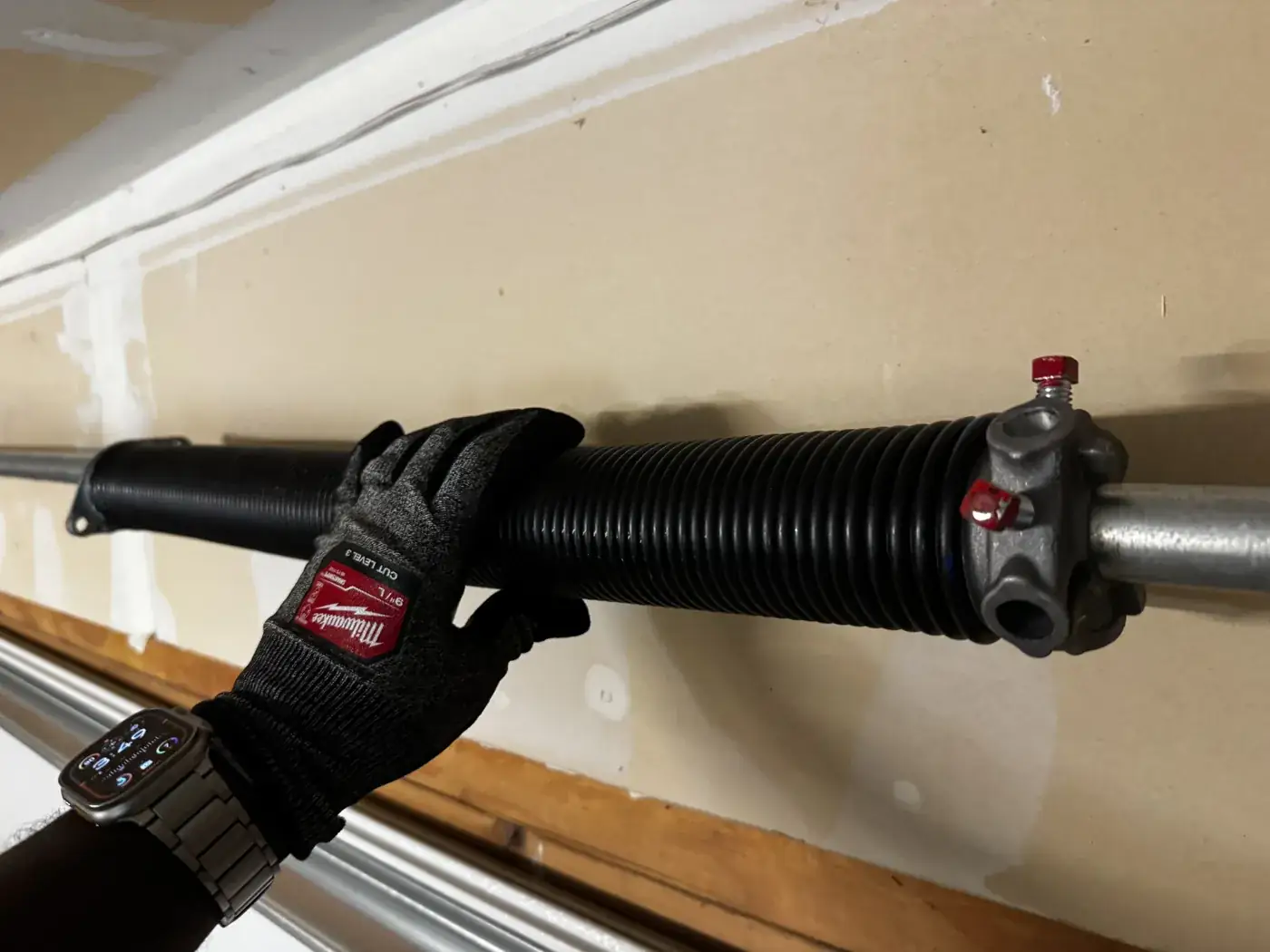
New torsion spring on the shaft 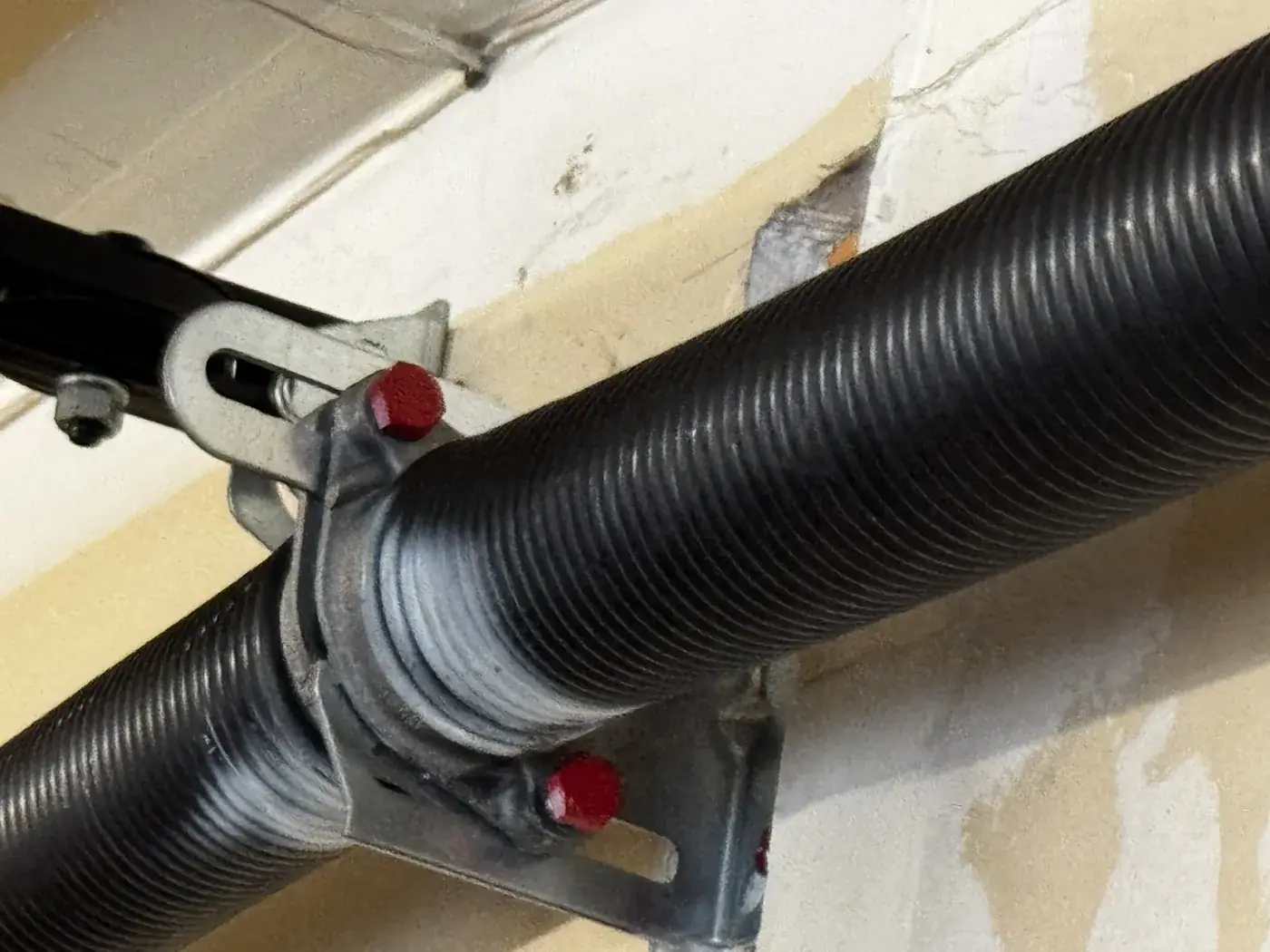
Centre bearing plate, springs either side
Start at Square One.
Tell us what your garage door is doing. You do not need to diagnose it before you call.