
Nothing happens when you press the button
Power at the outlet, a tripped GFCI, a dead remote battery, or a failed logic board. Wall-button-works-but-remote-doesn't narrows it quickly.
Usually safe to operate carefully until inspected.
Installation, troubleshooting, and setup — travel limits, force settings, safety sensors, remotes, and keypads. An opener should guide a balanced door, not fight it.
Opener faults are often adjustments rather than failures. The behaviour usually points straight at the cause.
Power at the outlet, a tripped GFCI, a dead remote battery, or a failed logic board. Wall-button-works-but-remote-doesn't narrows it quickly.
Usually safe to operate carefully until inspected.
Usually a stripped drive gear on a chain or belt unit, a detached trolley, or the emergency release still disengaged from a previous manual open.
Usually safe to operate carefully until inspected.
The down-travel limit is set slightly too far, so the opener reads the floor as an obstruction. A close-limit adjustment usually resolves it.
Usually safe to operate carefully until inspected.
Almost always the photo-eye safety sensors — knocked out of alignment, blocked by a stored item, or with a loose wire. The blink pattern often identifies which.
Usually safe to operate carefully until inspected.
A weak battery, a damaged antenna wire, or radio interference — LED bulbs in the opener head are a surprisingly frequent cause of lost range.
Usually safe to operate carefully until inspected.
Worn rollers and hardware transmitting noise, a chain that needs tensioning, or a motor beginning to fail. Worth diagnosing before it becomes a no-open.
Usually safe to operate carefully until inspected.
The long-standing default. Durable and lower cost, and the noisiest of the options — usually the wrong choice under a bedroom.
A reinforced rubber belt in place of the chain. Noticeably quieter, which matters most on attached garages and living space above.
A threaded steel rod with fewer moving parts. Less common now, and more sensitive to temperature swings than the alternatives.
Mounts beside the door on the torsion shaft rather than on the ceiling. Frees overhead space and removes the rail entirely — a good fit for high or tight ceilings.
Horsepower and drive type both follow from the door — its size, weight, and construction. We size the opener to the door you have.
Many opener problems are adjustments or individual parts — sensors, gears, trolleys, remotes, logic boards. Replacement makes more sense when parts are no longer available for the model, when the unit predates modern safety requirements, or when the repair cost approaches the cost of a current opener with a warranty behind it.
Photo-eye safety sensors. They project a beam across the opening, and the door will not close while that beam is broken. In the United States, residential openers manufactured after January 1, 1993 are federally required to include an external entrapment protection system of this kind. If yours are disconnected or bypassed, that is worth correcting regardless of anything else.
In most cases yes, provided the door itself is sound and properly balanced. Openers are matched to door size and weight, so an oversized, insulated, or solid-wood door may need a higher-horsepower unit. What an opener cannot do is compensate for a door that is out of balance — that has to be corrected first.
Because an opener's workload is set by the door. Travel limits and force settings are calibrated to a specific, balanced door; if the door is heavy or binding, those settings get pushed past where they should be and the opener wears out early. An opener that failed prematurely is often reporting a door problem.
Often, yes. Depending on the model, Wi-Fi connectivity, keypads, and additional remotes can be added without replacing the whole unit. Compatibility depends on the opener's age and its remote encoding, so it is worth confirming the model before buying accessories.
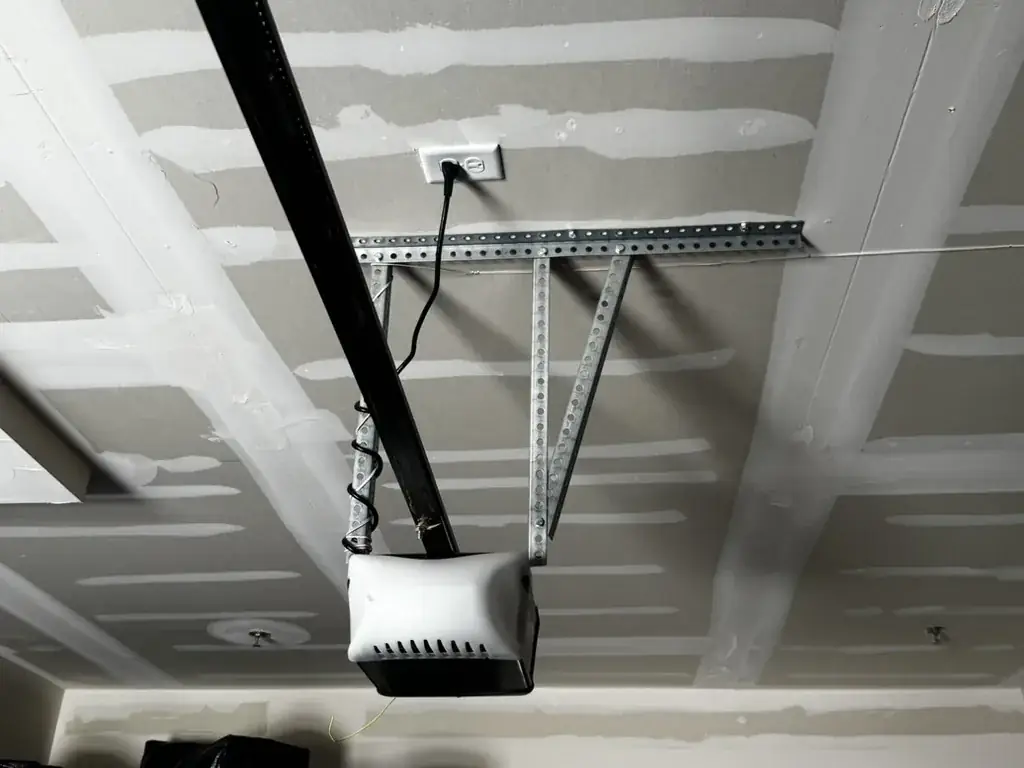
Hung from a ceiling bracket, rail running to the header.
Tell us what your garage door is doing. You do not need to diagnose it before you call.